

Key Takeaways
- The purpose of a dual-zone wine fridge is not simply to separate red wine from white wine. Its greater value lies in reducing temperature compromises across a mixed collection.
- Wine storage temperature and serving temperature are related, but they serve different purposes.
- When red, white, and sparkling wines share one fridge, zone planning should reflect the makeup of the collection, intended use, and temperature requirements rather than bottle color alone.
- Sparkling wine, crisp whites, and rosé often have compatible cooler-temperature requirements, while many reds and some fuller-bodied whites can be managed in a more moderate zone, depending on the collection.
- There is no single dual-zone configuration that remains ideal forever. As seasons, purchasing habits, and the composition of a collection change, the role of each zone may change as well.
When people first set up a dual-zone wine fridge, the instinct is usually simple: red wine in one zone and white wine in the other. For a household with a relatively straightforward collection, that approach can work perfectly well. Once the fridge starts holding Champagne, Sauvignon Blanc, Chardonnay, Pinot Noir, and Cabernet Sauvignon at the same time, however, the red-versus-white rule starts to show its limitations.
The reason is straightforward. A dual-zone wine fridge provides two independently controlled temperature environments, while a real household collection may contain several wine styles with different storage and serving needs. Sparkling wines generally benefit from cooler serving conditions. Crisp whites and fuller-bodied Chardonnay do not necessarily show their best at exactly the same temperature. Pinot Noir and Cabernet Sauvignon may both be red wines, but treating them as a single temperature category overlooks meaningful differences in structure and serving conditions.
So the more useful question is not simply, “Which side should hold red wine?” It is this: When one wine fridge needs to support storage, near-term drinking, and a mixed collection, how should its two temperature zones be used to minimize unnecessary compromise?
That question gets much closer to what it really means to understand how to use a dual-zone wine fridge.

What a Dual-Zone Wine Fridge Is Actually Designed to Solve
If a household primarily stores Bordeaux, Cabernet Sauvignon, or other wines with broadly similar temperature requirements, a stable single-zone wine fridge may already meet most of its needs. Dual-zone refrigeration becomes more useful as the collection becomes more diverse: white wine begins taking up more shelf space, Champagne and other sparkling wines are added, Pinot Noir appears alongside fuller-bodied reds, or seasonal drinking habits shift toward rosé and crisp whites.
At that point, the question is no longer whether the appliance can simply keep wine cool. The issue is that the collection contains bottles with different practical temperature needs. A single temperature setting inevitably creates some degree of compromise across the cabinet. Dual zones divide that one compromise into two independently managed environments.
There is an important distinction here. Dual-zone refrigeration does not give every wine its own ideal temperature. A cabinet with two zones may still hold four, five, or ten different wine styles, so some grouping remains necessary.
A more useful way to think about the technology is as two relatively stable temperature environments that allow a mixed collection to be managed more thoughtfully. The goal is not a perfect number for every bottle. It is better overall temperature management than forcing every wine to share the same setting.
In that sense, the value of a dual-zone wine fridge lies in temperature management rather than simple red-versus-white classification.
Storage Temperature and Serving Temperature Are Not the Same Thing
It is easy to blur the two, but storage temperature and serving temperature solve different problems.
For bottles that are not being opened immediately, storage is primarily about maintaining a consistent environment. Temperature stability matters because wine benefits from avoiding unnecessary fluctuations while it remains in the bottle. Constantly changing a wine fridge setting simply to prepare one specific bottle for dinner can work against one of the central purposes of dedicated wine refrigeration: providing a more controlled and predictable environment than general household refrigeration.
Serving temperature has a different function. It affects how a wine presents itself once it reaches the glass. Temperature can influence aromatic expression, the perception of acidity, body, tannin, freshness, and the way sparkling wine presents its carbonation. At lower temperatures, aromas may appear more restrained, while acidity and freshness can become more prominent. As the wine warms, aromatic expression and body generally become more apparent.

This is why categories such as “red wine temperature” and “white wine temperature” are useful only to a point. Champagne, Sauvignon Blanc, oak-influenced Chardonnay, Pinot Noir, and Cabernet Sauvignon do not necessarily show their best under identical conditions simply because some belong to the same color category.
If a homeowner tried to keep Champagne, Sauvignon Blanc, Chardonnay, Pinot Noir, and Cabernet Sauvignon permanently at their individual final serving temperatures, two zones would never be enough.
A more practical approach is to use the wine fridge to maintain stable baseline environments, then make the final adjustment before serving when necessary. A bottle may need a little additional chilling, or it may need some time outside the fridge to warm gradually before being poured.
The fridge manages the baseline. The final serving temperature remains specific to the bottle, wine style, producer guidance, and drinking context.
Before Setting the Zones, Look at the Collection Rather Than the Temperature Chart
Before deciding on dual-zone wine fridge settings, it helps to look at what is actually inside the cabinet.
Imagine one household whose collection is roughly 70 percent Cabernet Sauvignon and Bordeaux, with the remainder made up of Chardonnay and Sauvignon Blanc. Another household may drink mostly Champagne, rosé, and white wine while keeping only a few bottles of Pinot Noir. A third may have a genuinely mixed collection that includes Champagne, Chardonnay, Pinot Noir, Cabernet Sauvignon, and Syrah.
There is no reason all three households should use exactly the same zone configuration simply because they own the same type of wine fridge.
Three questions are more useful than asking which zone is “for” red or white wine: Which wines make up the largest part of the collection? Which bottles are likely to be opened in the near future? Which groups of wines have the greatest differences in temperature requirements?
The first question addresses collection composition. If most of the cabinet is occupied by red wine and white wine represents only a small portion of the collection, dividing the cabinet into equal conceptual “red” and “white” zones may not make efficient use of the available capacity. The reverse can be equally true during seasons when sparkling wines, rosé, and whites make up a larger share of the household’s purchases.
The second consideration is time. A Cabernet Sauvignon intended to remain unopened for an extended period and a Pinot Noir selected for dinner that evening are both red wines, but they are serving different roles within the cabinet. Zone management therefore benefits from considering bottle turnover as well as wine category.
Only after those questions have been considered does it make sense to examine temperature differences. The goal is not a perfect setting for every bottle. It is to identify the two most meaningful temperature groups within the actual collection.
That is the point at which dual-zone refrigeration becomes useful as a system rather than simply a feature.
What If You Have Red, White, and Sparkling Wine but Only Two Zones?
This is one of the most common realities of mixed wine storage: three or more categories of wine, but only two independently controlled zones.
The solution is to group wines according to compatible temperature requirements.
In many household collections, Champagne, Prosecco, Sauvignon Blanc, Pinot Grigio, and certain rosé wines can reasonably form a cooler-temperature group. These wines generally favor conditions that preserve freshness and support cooler serving temperatures, making them logical candidates to share the cooler of the two zones.
The other zone can then provide a more moderate environment for many red wines and, depending on the collection, some fuller-bodied whites. It should not automatically be regarded as a “red wine zone,” because wines such as Chardonnay may also fit there depending on the desired storage conditions, cabinet configuration, and how soon the bottles are likely to be opened.
The distinction within white wine is particularly important. Sauvignon Blanc and a fuller-bodied, oak-influenced Chardonnay should not automatically be treated as identical simply because both are white. Their structure and preferred serving conditions may differ enough that a varied collection benefits from more flexibility than a broad white-wine category implies.

The same applies to red wine. Pinot Noir and Cabernet Sauvignon belong to the same color category, yet their structure and typical serving conditions can differ substantially. Pinot Noir often shows well at a cooler temperature than a fuller-bodied Cabernet Sauvignon or Syrah. Treating all reds as one homogeneous group therefore creates the same oversimplification as treating all whites alike.
With only two temperature zones, some compromise is unavoidable. Good wine storage is not about eliminating every compromise. It is about deciding which differences are important enough to preserve and which can be handled at the point of service.
That principle is far more useful than trying to force every bottle into a rigid red, white, or sparkling rule.
| Wine Style | Typical Dual-Zone Role | Why It May Fit There | Final Adjustment Before Serving |
|---|---|---|---|
| Champagne & Sparkling Wine | Cooler group | Generally benefits from cooler conditions and can share space with crisp whites. | Additional chilling may be appropriate depending on style. |
| Sauvignon Blanc / Pinot Grigio | Cooler group | Often shares similar practical storage and near-term serving needs. | Often requires little adjustment. |
| Rosé | Cooler group | Commonly fits alongside sparkling wines and crisp whites. | Adjust according to style and preference. |
| Fuller-Bodied Chardonnay | Collection-dependent | May not require the same conditions as very crisp white wines. | May benefit from some warming before serving. |
| Pinot Noir | Collection-dependent | Often sits between typical white-wine and fuller red-wine serving needs. | Final temperature can be adjusted before pouring. |
| Cabernet Sauvignon / Syrah | More moderate group | Fuller-bodied reds generally fit better in the more moderate zone. | Can be brought closer to serving temperature before opening. |
Does the Upper Zone Always Hold White Wine and the Lower Zone Red Wine?
No. “Upper zone for whites, lower zone for reds” is better understood as a convenient convention than a universal rule for dual-zone wine fridges.
Different models can have different temperature ranges, cabinet layouts, zone capacities, airflow systems, and control logic. Before assigning any wine to a particular section, the first reference should therefore be the temperature range and operating guidance for the specific appliance.
Wine cooler dimensions and capacity matter as well. Suppose the lower compartment holds substantially more bottles and the household’s collection is approximately two-thirds red wine. In that case, the larger compartment may logically become the principal red-wine storage zone. A household that keeps substantially more Champagne, rosé, and white wine might make a different decision.
This is why the answer to what goes in each wine fridge zone cannot simply be “white on top and red below.”
A better sequence is to confirm the operating range of each zone first, then consider the actual ratio of wines in the collection and the capacity available in each compartment. Shelf configuration matters too. Bottle diameter, Burgundy and Champagne formats, shelf spacing, and the ability to accommodate oversized bottles can all affect how practical a theoretical zone plan is once the fridge is loaded.

A zone may technically reach the desired temperature while still being poorly suited to the collection because it does not provide enough usable capacity for the bottles intended to go there.
For that reason, evaluating a dual-zone wine fridge requires looking beyond the phrase “dual zone” itself. Useful specifications include the independent temperature range of each compartment, actual usable capacity, shelving configuration, and compatibility with the bottle formats a household regularly buys.
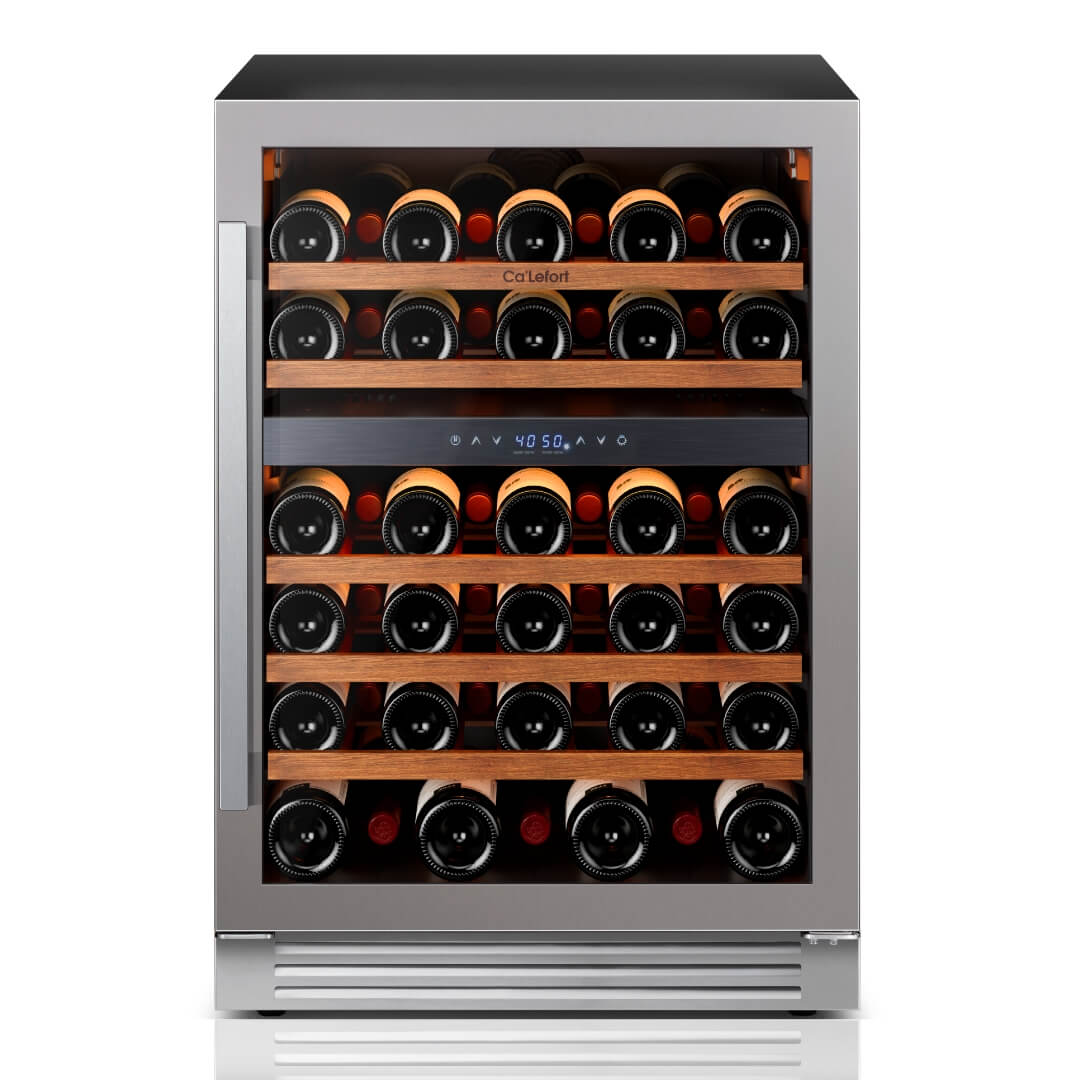
Ca'Lefort 24 inch Dual Zone Wine Fridge
A Dual-Zone Setup Should Not Be Treated as Permanent
A mixed wine collection is rarely static, so the role of each zone does not need to remain permanently fixed.
Seasonal changes are one obvious reason. During summer, a household may buy more Sauvignon Blanc, rosé, Champagne, and other sparkling wines, increasing the amount of cooler-zone capacity it actually uses. In autumn and winter, the balance may shift toward Cabernet Sauvignon, Syrah, Bordeaux blends, and other reds, changing the relative importance of the second zone.
The collection itself can also evolve. A new wine-fridge owner may initially buy mostly bottles intended for near-term drinking. Over time, some purchases may begin to stay in the cabinet longer, changing the role of the appliance from primarily keeping wine ready for frequent use to supporting more deliberate storage.
Changes in the types of wine being purchased matter as well. Someone who once kept almost exclusively Cabernet Sauvignon may gradually develop an interest in Chardonnay, Champagne, or Pinot Noir. The original zone configuration may still work, but it may no longer represent the most practical use of the cabinet.
None of this means that temperature settings should be changed every time a few new bottles are added. Frequent adjustment would work against the consistency that dedicated wine refrigeration is intended to provide.
A better approach is to review the setup when there has been a meaningful change in the composition of the collection, rather than reacting to individual bottles. The temperature zones can then remain stable until the collection changes enough to justify another reassessment.
Stability remains one of the foundational values of a dedicated wine fridge.
What Dual-Zone Refrigeration Really Gives You Is More Control Over a Mixed Collection
A dual-zone wine fridge is more than a cabinet with white wine on one side and red wine on the other.
For a simple collection, that division may be completely appropriate. But once the cabinet contains Champagne, Sauvignon Blanc, Chardonnay, Pinot Noir, Cabernet Sauvignon, and other styles, effective temperature management requires a broader understanding of wine style, collection composition, intended storage period, and the difference between storage and serving conditions.
The purpose of two zones is not to give five different wines five different temperatures. It is to separate the most meaningful differences within the collection while maintaining two stable environments, leaving smaller serving adjustments for the period immediately before the bottle is opened.
That distinction matters because a wine fridge should not require constant attention to individual temperature numbers. A well-planned dual-zone system should instead create a predictable environment: you know which wines are being kept under cooler conditions, which are held more moderately, and which bottles may need a small adjustment before serving.
For a mixed wine collection, that is the real advantage of dual-zone refrigeration. It does not remove every temperature compromise. It gives you enough control to make those compromises deliberately rather than accidentally.
Frequently Asked Questions
1. Do different bottle shapes affect the actual capacity of a dual-zone wine fridge?
Yes. Advertised capacity is typically calculated using a particular standard bottle format. Champagne, Burgundy, and other wider or oversized bottles can require more shelf space, so a mixed collection may hold fewer bottles than the stated maximum capacity.
2. Do I need a dual-zone wine fridge if I mostly collect red wine?
Not necessarily. If most of your collection has similar storage requirements, a single-zone wine fridge may be sufficient. Dual zones become more useful when the collection contains wines with meaningfully different temperature needs or when separate temperature control is genuinely useful.
3. What is the difference between one dual-zone wine fridge and two single-zone wine fridges?
Both approaches can provide separate temperature environments, but they differ in footprint, capacity allocation, installation, and flexibility. A dual-zone unit can consolidate two temperature environments within one appliance, while two independent fridges provide fully separate storage capacity and controls.
4. What should I look for in a dual-zone wine fridge besides temperature range?
Look at usable capacity in each zone, shelving layout, bottle-format compatibility, installation type, ventilation requirements, and door clearance. For a mixed collection, whether each compartment can practically accommodate the bottles you regularly buy can be just as important as its temperature range.
5. Does frequently opening a wine fridge door affect the internal temperature?
Opening the door temporarily introduces warmer ambient air, so short-term temperature changes are normal. There is usually no reason to change the set temperature in response to a brief fluctuation on the display. Avoiding unnecessarily long door openings and allowing the cooling system to recover is more important.


