

Key Takeaways
- Built-in and freestanding mainly describe the installation environment an appliance is designed to work in.
- Undercounter describes the appliance’s position beneath a countertop, while built-in describes whether it is designed to operate within cabinetry.
- Panel-ready describes a door designed to accept a custom cabinet panel. Cooling and ventilation requirements still depend on the appliance design.
- A nominal 15-inch or 24-inch width is a product class, not a substitute for actual appliance dimensions, cutout dimensions, or required clearances.
- Physical fit is only one part of installation compatibility. Ventilation, door operation, electrical placement, and required clearances matter as well.
- The installation instructions for the specific model should always guide the final installation.

Shopping for a wine fridge can become confusing when product descriptions use terms such as built-in, undercounter, freestanding, and panel-ready. They are often presented as four separate product categories, when each term actually answers a different question about the same appliance.
Some describe whether a wine fridge can operate within cabinetry. Others describe where it is installed or how its door integrates with the surrounding cabinets. A single wine fridge can therefore be built-in, undercounter, and panel-ready at the same time. Another model may support both built-in and freestanding installation.
The more useful question is how these conditions work together. Ventilation design, appliance dimensions, installation position, door configuration, and cabinet requirements all need to suit the project as a whole.
For homeowners planning a kitchen remodel, home bar, or butler’s pantry, this decision is best made before cabinet production and electrical placement are finalized. As entertaining moves back indoors in the fall, confirming the installation type early is more reliable than completing the cabinetry first and then searching for an appliance that appears to be approximately the right size.
Start With the Right Framework: What Question Does Each Label Answer?
Each of these terms answers a specific question. Once those questions are separated, the labels become much easier to understand.
| Label | Main Question It Answers | What It Usually Indicates | What It Does Not Automatically Mean |
|---|---|---|---|
| Built-In | Can the appliance operate within cabinetry? | It supports installation inside a specified cabinet opening or beneath a countertop. | It is not necessarily panel-ready or compatible with every opening. |
| Freestanding | Is the appliance designed for open placement? | It requires the surrounding airflow and placement conditions stated by the manufacturer. | A physical fit does not mean the appliance can be enclosed. |
| Undercounter | Where is the appliance installed? | Its size and configuration are intended for a location beneath a countertop. | It does not by itself confirm that the appliance supports built-in installation. |
| Panel-Ready | How does the door integrate with cabinetry? | The door can accept a compatible custom cabinet panel. | The panel may not be included, and installation clearances still apply. |
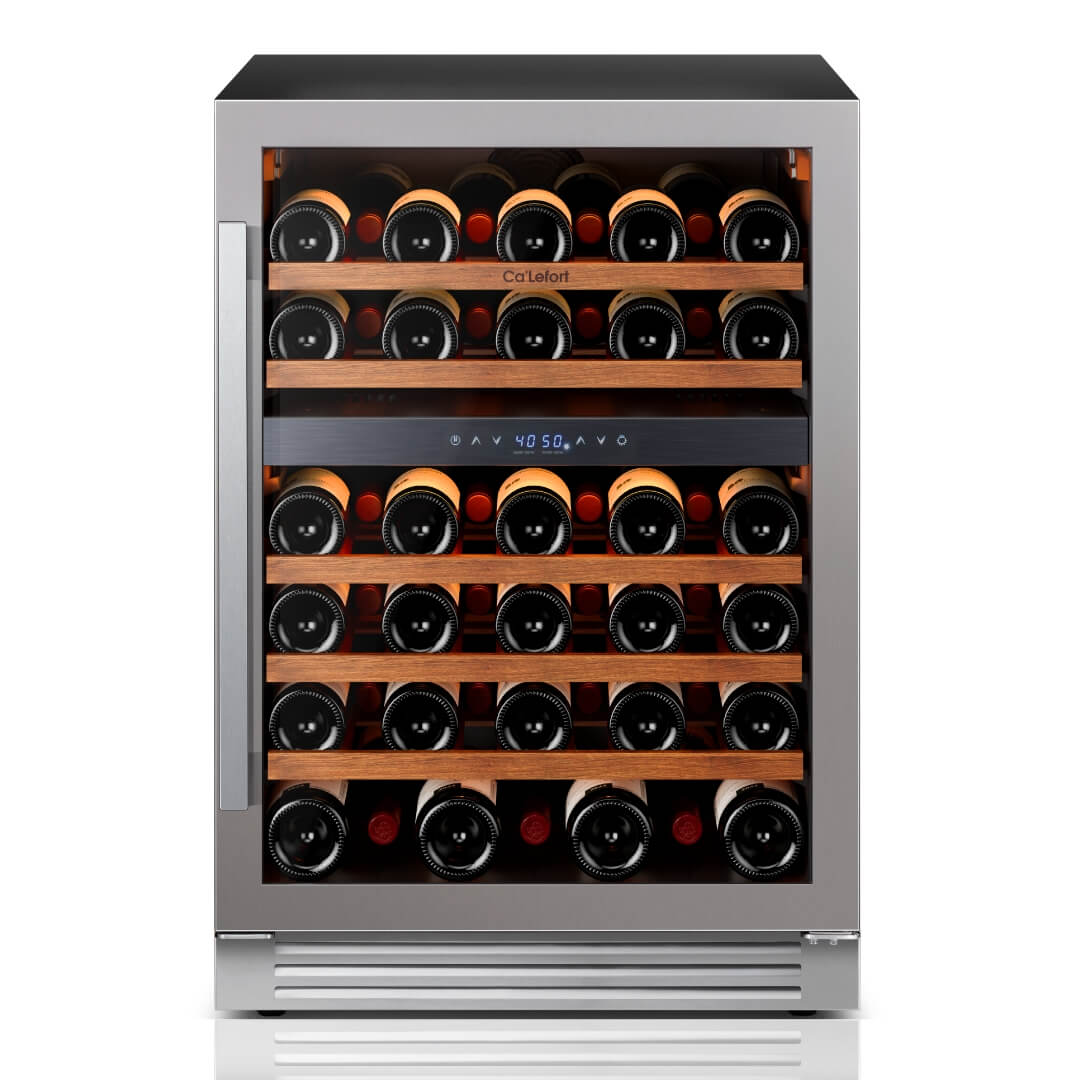
Ca'Lefort 24 inch Dual Zone Wine Fridge
Built-In Answers: “Can This Appliance Operate Within Cabinetry?”
A built-in wine fridge is designed for installation inside a cabinet opening, beneath a kitchen island, or within a fixed home bar. Because cabinetry creates a more enclosed environment, built-in models commonly use a ventilation system designed to manage heat without relying entirely on open space around the appliance.
Built-in capability still comes with model-specific installation requirements. Some wine fridges need space at the top, sides, or rear, and the ventilation grille must remain unobstructed by a toe kick, decorative trim, carpeting, or a custom cabinet panel.
Cabinet dimensions, countertop depth, electrical placement, and door clearance should all be checked against the installation instructions for the exact model.
Built-in and panel-ready also describe different things. Many built-in wine fridges retain their original glass door, metal frame, and appliance handle. They integrate physically with the cabinetry while remaining visually recognizable as an appliance.
Freestanding Answers: “Is This Appliance Designed for Open Placement?”
A freestanding wine fridge is primarily designed for placement in a relatively open area. It may sit along a kitchen wall, beside a home bar, or in another location that meets its operating requirements. Because it depends less on custom cabinetry, it can offer more flexibility if the room layout changes later.
That flexibility still comes with installation requirements. The appliance needs a stable, level surface and the amount of surrounding space specified by the manufacturer. Some models rely on airflow around the rear or sides to release heat, so placing one inside a tight cabinet enclosure can interfere with cooling even when the appliance physically fits.
A matching width alone is not enough to make a freestanding wine fridge suitable for cabinetry. Before placing one inside an enclosure, confirm that the manufacturer specifically approves built-in installation. Otherwise, plan for the open placement environment the appliance was designed to use.
Undercounter Answers: “Where Is the Wine Fridge Installed?”
Undercounter describes an installation beneath a countertop, where the appliance aligns with lower cabinets, an island, or a bar. Its placement is only part of the equation; the appliance must also be designed for the surrounding cabinet environment.
Many wine fridges designed specifically for undercounter installation also support built-in use, although product naming is not always consistent. A counter-height freestanding model, for example, may be promoted for a small kitchen or bar area without being suitable for enclosure between cabinets.
A true undercounter installation depends on three conditions:
- The appliance height and depth must work with the countertop and cabinet structure.
- Its ventilation design must support the intended cabinet environment.
- Its door and handle must operate without colliding with nearby walls, drawers, cabinet doors, or corners.
Undercounter tells where the appliance goes. Built-in tells whether it can operate correctly once it is there.
Panel-Ready Answers: “How Will the Door Integrate With the Cabinets?”
A panel-ready wine fridge brings the appliance door into the surrounding cabinetry through a compatible custom panel, creating a more continuous visual relationship with the space.
The cooling and ventilation requirements still come from the appliance’s installation design. Most panel-ready wine fridges are also built-in appliances, while a standard built-in model may retain its original door and may not be designed to accept a custom panel.
Panel-ready projects require more coordination than standard built-in installations. The cabinetmaker and installer may need to confirm:
- Panel dimensions and thickness
- Maximum panel weight
- Hinge configuration
- Handle position
- Door reveals
- Opening direction
- Clearance from adjacent cabinets
- Ventilation grille location
A panel-ready designation also does not necessarily mean that a finished panel or handle is included. In many projects, the cabinetmaker produces the panel according to the appliance specifications, and the installer attaches it during installation.
Built-In vs. Freestanding Wine Fridges: Seven Differences That Matter
The difference between a built-in and freestanding wine fridge goes beyond whether one sits inside cabinetry and the other stands in the open. Installation type can affect airflow, cabinet dimensions, electrical placement, door operation, visual integration, service access, and future flexibility.
1. Ventilation Path
A wine fridge removes heat from its interior and releases it into the surrounding environment. Built-in models commonly use a ventilation design suitable for cabinetry, but front ventilation is only one part of the installation.
The plan should identify where air enters, where heat exits, and whether cabinet details could block that path. A front grille covered by a toe kick, trim piece, thick rug, or custom panel may no longer perform as intended.
Freestanding models may depend more heavily on open space around the appliance, including the rear or sides. Clearance requirements vary by model, so the installation instructions for the exact wine fridge should guide the final setup.
2. Product Dimensions, Cutout Dimensions, and Clearances
A wine fridge installation involves at least three different sets of measurements:
- Product dimensions: the width, height, and depth of the appliance itself
- Cutout dimensions: the cabinet opening recommended for installation
- Clearances: any additional space required for ventilation, leveling, door operation, or service access
These measurements are related, but they serve different purposes.
Product width determines whether the appliance can physically enter the opening. Cutout dimensions indicate whether the surrounding cabinetry meets the installation requirements.
Clearances affect how the appliance operates and how comfortably it can be used after installation.
A label such as “24-inch wine fridge” usually identifies a general size class. The actual appliance may be slightly narrower than 24 inches, and individual models can still require different openings.
Real cabinet openings also vary. Walls may not be perfectly square. Flooring may raise one side of the opening. Countertops can sag slightly, while trim or face frames may reduce usable width. Measure the opening at multiple points and work from the narrowest width, lowest height, and shallowest usable depth.
3. Electrical Placement and Final Installed Depth
A wine fridge may appear to match the cabinet depth on paper and still project beyond the cabinet line after installation. The outlet, plug, power cord, cabinet back, or wall condition may add depth that is easy to overlook during planning.
Electrical placement should follow the model’s installation instructions and applicable local electrical requirements. The outlet should allow the appliance to reach its intended position while remaining reasonably accessible for service.
Voltage, outlet type, and any dedicated-circuit requirements should be confirmed for the specific appliance and local jurisdiction. Product documentation and professional electrical guidance should take priority over general online advice.
4. Door Swing and Shelf Extension
A door that opens is not necessarily a door that opens far enough.
Handles, adjacent drawers, return walls, corner cabinets, kitchen islands, and nearby appliances may restrict the usable opening angle. If the door cannot reach the angle required by the product design, pull-out shelves may not extend fully.
For a built-in installation, confirm:
- Whether the door opens to the left or right
- Whether the hinge is reversible
- Whether the handle will hit a wall or cabinet
- Whether the open door enters a major walkway
- Whether shelves can extend fully
- Whether a custom panel changes the door’s thickness or swing path
Corner installations deserve particular attention. Even when the appliance face aligns neatly with the cabinetry, the hinge side may require additional space from an adjacent wall or perpendicular cabinet run.

5. Degree of Visual Integration
Wine fridge installations generally fall into three visual levels.
The first is freestanding placement, where the top, sides, and door of the appliance remain visible.
The second is a standard built-in installation. The appliance body sits within the cabinetry, while the original glass door, metal frame, or appliance handle remains visible.
The third is a panel-ready built-in installation. A custom panel brings the appliance door into the same visual language as the surrounding cabinetry.
Each approach supports a different kind of space. A glass door keeps the collection visible and allows users to check inventory without opening the appliance. A panel-ready door creates a quieter, more continuous cabinet elevation. Freestanding placement preserves more flexibility if the room changes later.
The right choice depends on how visible the appliance should be and how much cabinet coordination the project can support.
6. Future Service and Replacement
Cabinet planning should account for more than the first installation. It should also consider how the wine fridge will be removed, serviced, and eventually replaced.
Countertop edges, trim, toe kicks, adjacent doors, and custom panels should allow reasonable access to the appliance. In a panel-ready project, the custom panel may also need to be removed safely before certain service work can be completed.
An opening designed too closely around the exterior dimensions of one exact appliance may restrict future replacement options. Long-term kitchen projects benefit from clearly documented cutout dimensions, electrical placement, panel drawings, and model information.
Keeping these records makes future service or replacement more manageable and reduces the need to remeasure the entire installation.
7. Project Flexibility
Built-in and panel-ready wine fridges are well suited to projects with a defined long-term layout. They can create a more integrated result, but they require earlier coordination among the appliance specifications, cabinetry, electrical work, and door design.
Freestanding models depend less on permanent millwork and may suit renters, homeowners who expect to move, or rooms that are still evolving.
Their flexibility does not remove basic operating requirements. A freestanding wine fridge still needs adequate airflow, stable flooring, a suitable ambient environment, and enough room for the door to operate safely.
| Comparison | Built-In | Freestanding |
|---|---|---|
| Primary installation environment | Cabinet opening, kitchen island, or fixed home bar | Relatively open location |
| Ventilation review | Designed for specified cabinet conditions, although model-specific clearance requirements still apply | Often depends more heavily on open space around the appliance |
| Cabinet coordination | Cutout dimensions, countertop depth, outlet location, and door operation must be reviewed | Less dependent on custom cabinetry |
| Visual result | Can create an integrated appearance; some models also support a custom cabinet panel | The full appliance exterior remains visible |
| Planning stage | Best selected before cabinet production begins | Can often be selected after the room is complete, subject to space and ventilation requirements |
| Future repositioning | Usually remains tied to the cabinet opening | Typically easier to relocate |
| Best suited for | Kitchen remodels, fixed home bars, and custom cabinetry projects | Projects without cabinet modifications or with layouts that may change |
Why Undercounter Should Not Be Used as a Synonym for Built-In
Built-in and undercounter describe two different parts of the installation. Built-in addresses whether the appliance can operate within cabinetry. Undercounter identifies its position beneath a countertop.
The terms often appear together because many undercounter wine fridges are also built-in. Still, both conditions need to be checked.
A typical undercounter wine fridge must be low enough to fit between the floor and countertop. Its depth should coordinate with the lower cabinets, countertop edge, and finished door line. At the same time, its ventilation system needs to suit the surrounding cabinet conditions.
A counter-height freestanding wine fridge placed beside a bar or beneath an open surface may look similar to an undercounter appliance while having very different ventilation requirements.
Before purchasing an undercounter wine fridge, confirm:
- Whether the manufacturer explicitly permits installation beneath a counter
- Where the ventilation intake and exhaust are located
- The recommended cutout dimensions
- Whether the front grille must remain fully exposed
- Whether the countertop, cabinet back, or adjacent panels require additional space
- How far the door must open for the shelves to extend
Undercounter determines where the appliance sits. Built-in determines whether it can operate correctly once it is there. A successful undercounter installation needs both conditions to work together.
How Is Panel-Ready Different From a Standard Built-In Wine Fridge?
A standard built-in wine fridge addresses how the appliance fits inside cabinetry. A panel-ready model goes one step further by addressing how the door becomes part of the cabinet design.
After a standard built-in installation, the glass door, frame, and appliance handle remain visible. This can work well in a kitchen or home bar where the collection should remain easy to see and the appliance is intended to have a clear visual presence.
A panel-ready wine fridge uses a compatible custom panel to coordinate with the surrounding cabinetry. The panel needs to meet the appliance’s specifications rather than simply copy the dimensions of a nearby cabinet door.
Panel specifications matter because:
- Excessive weight can affect door balance.
- Incorrect dimensions can produce uneven reveals.
- A thick edge or oversized handle can collide with nearby cabinetry.
- Added panel depth can alter the swing path.
- Decorative details can interfere with the ventilation grille.

The ventilation system still needs to function correctly after the panel is installed. A seamless cabinet elevation works only when the appliance’s operating requirements remain intact.
The most successful panel-ready projects treat the appliance, custom panel, handle, hinge, cabinet reveals, and ventilation path as one coordinated system.
If the cabinets are already in production, adding a panel-ready wine fridge may require more revision than adding a standard built-in model. In a new kitchen or major remodel, the more reliable sequence is to select the appliance first and then provide its documentation to the designer, cabinetmaker, and installer.
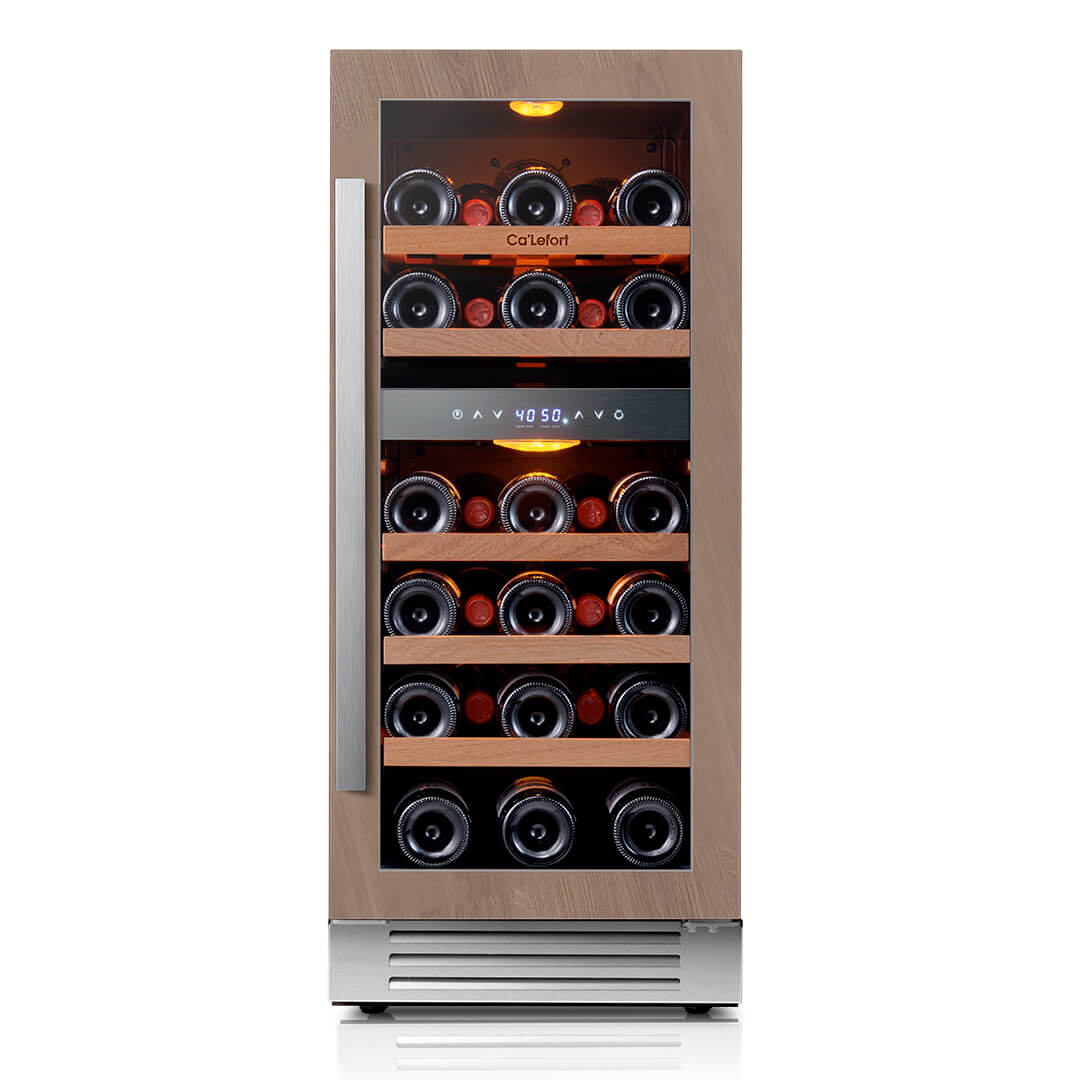
15-Inch Panel Ready Wine Fridge
How These Labels Combine in Real Installations
These terms are not mutually exclusive. In real projects, several labels can describe the same appliance.
Standard-Door Undercounter Built-In Wine Fridge
This is a common built-in and undercounter combination. The appliance sits beneath a kitchen or bar countertop while retaining its original glass or metal-framed door.
It can work well with an existing standard opening when the homeowner does not need a custom cabinet panel. The primary checks are cutout dimensions, ventilation, installed depth, electrical placement, hinge direction, handle clearance, and shelf extension.
Panel-Ready Undercounter Built-In Wine Fridge
This installation combines built-in, undercounter, and panel-ready characteristics. The appliance operates within cabinetry, sits below the countertop, and accepts a custom door panel.
It is well suited to a new kitchen or a project with active cabinet design coordination. In addition to the standard built-in requirements, the team must confirm panel size, weight, hinge details, handle location, door reveals, adjacent cabinet clearances, and an unobstructed ventilation path.
A Built-In-Capable Model Used as Freestanding
Some built-in-capable models are also approved for freestanding use. This can provide useful project flexibility. The appliance may be used freestanding initially and integrated into cabinetry during a later remodel.
That flexibility should be confirmed in the manufacturer’s documentation rather than inferred from features such as a front ventilation grille. When the appliance is used freestanding, the side finish, stability, placement conditions, and required surrounding space should also be considered.
Tall wine fridges form a separate physical category. They are not undercounter appliances, although individual tall models may be freestanding or approved for a specific built-in installation. Their countertop height, cabinet opening, and door relationships should be evaluated according to the requirements of the individual model.
Do Not Ask Which Type Is Best Until You Identify the Project
Installation decisions should begin with the conditions of the project, not with a lifestyle image or product feature list.
New Kitchen or Major Remodel
When the cabinets have not yet been produced, the project has the greatest flexibility. Select the wine fridge first, then coordinate the cabinet opening, electrical location, countertop, ventilation, and door configuration around the exact model.
A standard built-in model may suit a kitchen where the glass door and collection should remain visible. A panel-ready model may be more appropriate when the design calls for a continuous cabinet elevation.
In either case, asking the cabinetmaker simply to “leave a 24-inch opening” is not enough. The final drawing should reflect the appliance’s actual dimensions and installation requirements.
Existing 15-Inch or 24-Inch Opening
An existing opening places stronger limits on product selection. Measure the narrowest width, lowest height, and usable depth. Then account for the outlet, plug, cabinet back, toe kick, countertop edge, and adjacent doors.
Before ordering a model that appears close in size, review its built-in approval, ventilation path, hinge direction, door clearance, and shelf extension.
In this type of project, installation compatibility should come before finish preferences. Capacity, temperature zones, and other features can then be compared among models that have already passed the physical and technical review.
Home Bar or Butler’s Pantry Update
If the home bar includes a fixed countertop and lower cabinets, an undercounter built-in model is often a logical direction. From there, the choice between a visible standard door and a panel-ready door depends on the desired level of visual integration.
If the area has no fixed cabinetry and no millwork is planned, a freestanding model may be more appropriate. Adding an enclosure solely to create a built-in appearance can introduce cabinet and ventilation requirements that the project otherwise would not have.
No Cabinet Modifications or a Possible Future Move
Renters, homeowners planning a future move, or households that expect the room’s function to change may value placement flexibility more than permanent integration.
A freestanding wine fridge, or a model explicitly approved for both installation methods, can reduce dependence on existing cabinetry.
The appliance still needs the required airflow, stable flooring, suitable ambient conditions, and safe door clearance. Its flexibility comes from placement, not from an absence of installation requirements.
Visual Continuity Is the Main Design Priority
A panel-ready model may be a natural fit when an interior designer and cabinetmaker are already involved and the kitchen depends on continuous materials and cabinet lines.
This choice requires more coordination. The custom panel, hardware, reveals, ventilation grille, and door operation should be resolved together. Completing the cabinetry first and searching for a panel-ready appliance afterward may reduce the available model choices and create avoidable revisions.
| Project Condition | Installation Direction to Evaluate First | Critical Checks |
|---|---|---|
| New kitchen or major remodel | Built-in or panel-ready | Final appliance model, cabinet cutout, outlet placement, custom panel, and cabinet drawings |
| Existing standard opening | Standard built-in or undercounter | Actual opening dimensions, ventilation, installed depth, hinge direction, and door swing |
| Fixed home bar | Undercounter built-in | Countertop depth, ventilation grille, handle projection, and clearance from adjacent cabinets |
| No cabinet modifications | Freestanding | Surrounding airflow, flooring, nearby heat sources, electrical access, and door clearance |
| Layout may change later | Freestanding or dual-installation model | Manufacturer approval for the intended installation method and the space required in each configuration |

How to Read Product Specifications Before Choosing an Installation Type
A product title helps narrow the search. The specification sheet and installation manual determine whether the appliance belongs in the project.
1. Actual Appliance Dimensions
Record the width, height, and depth. Confirm whether the listed depth includes the door, handle, hinges, or other projections. A nominal 15-inch or 24-inch class should not be used as a construction measurement.
2. Recommended Cutout Dimensions
If the manufacturer provides cutout dimensions, compare those measurements directly with the existing opening or cabinet drawing. The required opening may differ from the appliance’s exterior dimensions.
3. Ventilation Location
Identify where air enters and where heat leaves the appliance. Check whether a toe kick, cabinet panel, carpet, trim, or other design detail could block that path.
4. Installation Clearances
Review any top, side, and rear requirements. Front ventilation addresses one part of airflow, while the remaining installation surfaces still need to follow the clearances specified for the model.
5. Door and Handle Projection
The published cabinet depth may not include the handle. The open door may also extend beyond the body width and affect a nearby wall, drawer, walkway, or cabinet door.
6. Hinge Configuration
Confirm the hinge side and whether the door can be reversed. For a panel-ready model, verify how the custom panel affects hinge movement and door clearance.
7. Shelf Extension Requirements
The door needs to open far enough for the shelves to extend as designed. A partially open door may provide access to the interior without allowing comfortable use of pull-out shelving.
8. Electrical Requirements
Check voltage, plug configuration, cord length, and recommended outlet placement. Electrical work and circuit requirements should be confirmed by an appropriate professional under local rules.
9. Panel-Ready Door Specifications
Review panel dimensions, thickness, weight, attachment points, handle requirements, and hardware details. Also confirm whether the panel and handle are supplied separately.
10. Installation Environment
Indoor kitchens, garages, basements, enclosed patios, and outdoor kitchens create different temperature and exposure conditions. Confirm the model’s approved ambient range and installation location before choosing where it will be used.
An appliance designed for an indoor conditioned space may have different requirements from one specifically approved for outdoor or unconditioned environments.
Three Projects Can Lead to Three Different Answers
Consider three homeowners who are all shopping for a wine fridge.
The first already has a kitchen opening close to 24 inches wide and does not need a custom panel. A practical direction is a standard-door built-in undercounter model that satisfies the existing cutout, ventilation, electrical, and hinge conditions. A panel-ready door would add cabinet coordination without necessarily improving the project.
The second homeowner is designing a new kitchen and wants the wine fridge to align with the surrounding cabinet fronts. Because the opening, outlet, and door panel can still be adjusted, a panel-ready built-in model may better support the design. The appliance and panel specifications should be finalized before cabinet production.
The third homeowner has no fixed opening, and the home bar may be rearranged later. A freestanding model, or one specifically approved for both freestanding and built-in use, offers more flexibility. A tight custom enclosure would add a limitation the project does not currently require.
All three homeowners need wine storage, but their project conditions lead to different installation combinations. Capacity and appearance are important, but they make more sense once the installation requirements are clear.
Confirm Installation Compatibility Before Comparing Capacity and Temperature Zones
Installation type is not the entire buying decision, but it should be the first filter.
A more reliable selection order is:
- Decide whether the appliance will enter cabinetry or stand in an open location.
- Determine whether it will sit beneath a countertop.
- Decide whether the door needs a custom cabinet panel.
- Verify the dimensions, ventilation, electrical requirements, and door conditions for the specific model.
- Compare single-zone and dual-zone options among compatible models.
- Estimate useful capacity based on the bottle shapes the household actually stores.
- Compare shelving, temperature range, operating sound, finish, and price.
Following this sequence helps keep the shortlist focused on models that can actually work in the space.
Installation compatibility determines which models belong on that shortlist. Features then help determine which compatible model best supports everyday use.
Conclusion: Choose a Set of Compatible Conditions, Not a Single Label
Built-in, undercounter, freestanding, and panel-ready work best when understood as parts of the same installation picture. Together, they describe how a wine fridge fits into the space, releases heat, relates to the countertop, and appears within the cabinet elevation.
A practical decision comes down to four questions:
- Does the wine fridge need to operate inside cabinetry?
- Will it be installed beneath a countertop?
- Does the door need a custom cabinet panel?
- Do the dimensions, ventilation, electrical requirements, and door conditions of the specific model match the project?
For homeowners planning a kitchen, home bar, or fall entertaining space, fit involves more than matching appliance width to an opening. The cabinetry, airflow path, door, electrical placement, and long-term use all need to work together.
The right wine fridge does not need to become the most prominent object in the room. It should fit the architecture, support the household’s routines, and quietly become part of the home.


